

CG Structure · 2025
In this section22 topics
- Board Composition8 items
- Board of Directors1 item
- Board Meetings & Remuneration5 items
- Directors Who Left During the Year1 item
- Balance of Power Between the Board and Management5 items
- Board Roles, Duties and Charter3 items
- Other Board Governance Matters1 item
- Subcommittees — Overview2 items
- Audit Committee6 items
- Executive Committee6 items
- Other Subcommittees2 items
- Executives2 items
- Executive Remuneration4 items
- Remuneration Policy5 items
- Employees1 item
- Employee Remuneration1 item
- Provident Fund3 items
- Policy for Employees Not in the Provident Fund5 items
- Auditors and Audit Fees2 items
- Company Secretary and Other Assigned Persons7 items
- Investor Relations Contact3 items
- Representatives in Thailand (Foreign Companies)1 item
Board Composition
Total Number of Directors
9
Male Directors
6
Female Directors
3
Independent Directors
3
Non-executive Directors
4
Non-executive Directors Who Are Not Independent
1
Executive Directors
5
Total Board Meetings Held
5
Board of Directors
Directors
| Title | First Name | Last Name | Gender | Year of Birth | Nationality | Resident in Thailand? | Position | Executive or Non-executive | Independent Director? | Director Type | Appointment Date | Authorised to Sign? | Related to Another Director or Executive? | Any Legal Violation in the Past 5 Years? | Highest Education | Field of Study | Field of Study — Please Specify | Skills & Expertise | Director Training | Attended Director Training? | Director Accreditation Program (DAP)? | Director Certification Program (DCP)? | Board Meetings Held | Board Meetings Attended | AGMs Held | AGMs Attended | Meeting Allowance (Baht) | Other Remuneration (Baht) | Total Remuneration (Baht) | Remuneration from Subsidiaries (Baht) | Non-monetary Remuneration | Shares Held | Shareholding (%) | Shares Held by Related Persons (s.59) | Shareholding by Related Persons (s.59, %) |
|---|---|---|---|---|---|---|---|---|---|---|---|---|---|---|---|---|---|---|---|---|---|---|---|---|---|---|---|---|---|---|---|---|---|---|---|
| Mr. | Niphon | Bundechanan | M | 1,971 | 643 · Description: Thailand | Y | Chairman of the board | Non-executive | Y | Continuing director (Full term of directorship and being re-appointed as a director) | 2019-11-11T00:00 | N | N | N | Doctoral degree | other | Industrial Management | 165 · Description: Risk Management · 163 · Description: Leadership · 164 · Description: Strategic Management · 158 · Description: Corporate Management · 167 · Description: Internal Control | 1727 · Year: 2023 · Description: Advanced Audit Committee Program (AACP) · 1732 · Year: 2021 · Description: Director Leadership Certification Program (DLCP) · 1739 · Year: 2011 · Description: Successful Formulation & Execution of Strategy (SFE) · 2010 · Description: Role of the Compensation Committee (RCC) · 1734 · Year: 2010 · Description: Financial Statements for Directors (FSD) · 1731 · Year: 2009 · Description: Director Certification Program (DCP) · 2024 · Description: Sustainability-related Financial Disclosures by Thai and ASWAN Companies · 1736 · Year: 2025 · Description: Role of the Chairman Program (RCP) · 2025 · Description: Advanced Management Program for Senior Executives (NIDA Advanced Management Program – AMP), Class 13/2025, National Institute of Development Administration (NIDA) · 2025 · Description: Seminar: “Insight in SET: ID & AC Focus – Enhancing Knowledge for Sustainable Growth in the Capital Market,” The Stock Exchange of Thailand (SET) | Y | N | Y | 5 | 5 | 1 | 1 | 360,000 | 0 | 360,000 | 0 | 0 | 600,000 | 0.1 | 0 | 0 |
| Mr. | Luck | Dendee | M | 1,969 | 643 · Description: Thailand | Y | Director | Executive | Existing director | 1997-10-06T00:00 | Y | N | N | Bachelor's degree | Business Administration | 146 · Description: Human Resource Management · 1683 · Description: Business Administration · 151 · Description: Data Management · 158 · Description: Corporate Management · 164 · Description: Strategic Management | 1730 · Year: 2018 · Description: Director Accreditation Program (DAP) · 2025 · Description: In-house Training: strategic thinking and planning for disruptive world | Y | Y | N | 5 | 5 | 1 | 1 | 0 | 0 | 0 | 0 | 0 | 48,078,000 | 8.01 | 0 | 0 | ||
| Ms. | Risara | Charoenpanich | F | 1,978 | 643 · Description: Thailand | Y | Director | Executive | Existing director | 2012-03-12T00:00 | Y | N | N | Master's degree | other | Marketing Communication | 1683 · Description: Business Administration · 142 · Description: Marketing · 163 · Description: Leadership · 164 · Description: Strategic Management · 146 · Description: Human Resource Management | 1730 · Year: 2017 · Description: Director Accreditation Program (DAP) · 1739 · Year: 2023 · Description: Successful Formulation & Execution of Strategy (SFE) · 2023 · Description: Corporate Governance for Executives 22/2023 · 2024 · Description: The 2nd Certified Management Accountant Program (CMA) 34/2024 · 2025 · Description: International Women’s Day Seminar 2025, Topic: “Empowering the Leaders of Tomorrow” · 2025 · Description: Seminar on “Transforming People in the Age of AI: The Real Driver of Change” · 2025 · Description: In-house Training: Recruitment Report Training · 2025 · Description: In-house Training: Presentation Skills Training | Y | Y | N | 5 | 5 | 1 | 1 | 0 | 0 | 0 | 0 | 0 | 100,531,765 | 16.76 | 26,082,500 | 4.35 | |
| Ms. | Onrudee | Kettawee | F | 1,980 | 643 · Description: Thailand | Y | Director | Executive | Existing director | 2018-10-03T00:00 | Y | N | N | Master's degree | other | Marketing | 1683 · Description: Business Administration · 112 · Description: Economics · 142 · Description: Marketing · 146 · Description: Human Resource Management · 164 · Description: Strategic Management | 1730 · Year: 2018 · Description: Director Accreditation Program (DAP) · 2025 · Description: AWS GenAI & Innovation Summit Thailand · 2025 · Description: Digital HR Forum 2025 · 2025 · Description: AI and Its Impact on Workforce Transformation | Y | Y | N | 5 | 5 | 1 | 1 | 0 | 0 | 0 | 0 | 0 | 90,325,883 | 15.05 | 2,368,900 | 0.39 | |
| Mr. | Chan | Itthithavorn | M | 1,968 | 643 · Description: Thailand | Y | Director | Non-executive | Y | Continuing director (Full term of directorship and being re-appointed as a director) | 2019-11-11T00:00 | N | N | N | Master's degree | Business Administration | 1683 · Description: Business Administration · 143 · Description: Accounting · 144 · Description: Finance · 150 · Description: IT Management · 167 · Description: Internal Control | 1730 · Year: 2019 · Description: Director Accreditation Program (DAP) · 1727 · Year: 2020 · Description: Advanced Audit Committee Program (AACP) · 2025 · Description: The Evolving Role of the Audit Committee in Fostering Trust and Transparency, Thai Institute of Directors Association (IOD) | Y | Y | N | 5 | 5 | 1 | 1 | 240,000 | 0 | 240,000 | 0 | 0 | 0 | 0 | 0 | 0 | |
| Mr. | Phukphong | Ratanaprapai | M | 1,971 | 643 · Description: Thailand | Y | Director | Executive | Existing director | 2019-11-11T00:00 | Y | N | N | Master's degree | Business Administration | 142 · Description: Marketing · 146 · Description: Human Resource Management · 1683 · Description: Business Administration · 158 · Description: Corporate Management · 163 · Description: Leadership | 1730 · Year: 2019 · Description: Director Accreditation Program (DAP) · 2025 · Description: In-house Training: AI for Business Transformation · 2025 · Description: In-house Training: “Customer Mind” – Building Customer Relationships | Y | Y | N | 5 | 5 | 1 | 1 | 0 | 0 | 0 | 0 | 0 | 2,330,661 | 0.39 | 0 | 0 | ||
| Ms. | Narita | Adulkaewphaluek | F | 1,977 | 643 · Description: Thailand | Y | Director | Executive | Existing director | 2019-11-11T00:00 | N | N | N | Master's degree | other | Management Information System | 143 · Description: Accounting · 147 · Description: Sustainability · 265 · Description: Governance/ Compliance · 150 · Description: IT Management · 141 · Description: Law | 1730 · Year: 2019 · Description: Director Accreditation Program (DAP) · 2020 · Description: Company Secretary Program (CSP), Class 105/2020 · 2017 · Description: Strategic CFO in Capital Markets Program, Minimum 12 hours, Class 5/2017, The Stock Exchange of Thailand · 2021 · Description: CFO’s Refresher Program, Class 2/2021 · 2024 · Description: Sustainability Knowledge for Corporate Employees, completed in February 2024 · 2024 · Description: ESG Risk Management, completed in June 2024 · 2024 · Description: ESG Risk Management Workshop, completed in July 2024 · 2025 · Description: DTX – Digital Transformation Xponential Program, Class 6, organized by RISE Accel Co., Ltd. · 2025 · Description: CFO Annual Conference on Capital Markets · 2025 · Description: JUMP+ Activation Day: Blueprint to Breakthrough · 2025 · Description: AWS GenAI & Innovation Summit Thailand · 2025 · Description: The Evolving Role of Audit Committee in Fostering Trust and Transparency | Y | Y | N | 5 | 5 | 1 | 1 | 0 | 0 | 0 | 0 | 0 | 2,728,859 | 0.45 | 0 | 0 | |
| Mr. | Metha | Angwattanapanich | M | 1,967 | 643 · Description: Thailand | Y | Director | Non-executive | Y | Existing director | 2024-04-25T00:00 | N | N | N | Master's degree | Business Administration | 159 · Description: Engineering · 1683 · Description: Business Administration · 165 · Description: Risk Management · 164 · Description: Strategic Management · 167 · Description: Internal Control | 1727 · Year: 2024 · Description: Advanced Audit Committee Program (AACP) · 2012 · Description: Senior Executive Program, Class 14 (WTT.14), Capital Market Academy · 2012 · Description: National Defence Course (NDC) Class 55, National Defence College · 2022 · Description: D-Startup Program, Batch 2, Sripatum University · 2021 · Description: The Next Real Course, Batch 10 · 1730 · Year: 2020 · Description: Director Accreditation Program (DAP) · 2025 · Description: Seminar: “Insight in SET: ID & AC Focus – Enhancing Knowledge for Growth and Sustainability in the Capital Market” | Y | Y | N | 5 | 5 | 1 | 1 | 240,000 | 0 | 240,000 | 0 | 0 | 0 | 0 | 0 | 0 | |
| Mr. | Ekaluck | Wangchucherdkul | M | 1,978 | 643 · Description: Thailand | Y | Director | Non-executive | N | Newly appointed director to replace the ex-director | 2025-11-10T00:00 | N | N | N | Master's degree | Business Administration | 164 · Description: Strategic Management · 144 · Description: Finance · 168 · Description: Budgeting · 1683 · Description: Business Administration · 119 · Description: Finance & Securities | 1731 · Year: 2016 · Description: Director Certification Program (DCP) · 2025 · Description: The Role of Chairman (RCM), Class 60/2025 | Y | N | Y | 1 | 1 | 0 | 0 | 0 | 0 | 0 | 0 | 0 | 0 | 0 | 0 | 0 |
Board Meetings & Remuneration
Date of the Annual General Meeting
2025-04-22T00:00
Was an Extraordinary General Meeting Held?
No
Board Meeting Allowance (Baht)
840000.0
Other Board Remuneration (Baht)
0.0
Total Board Remuneration (Baht)
840000.0
Directors Who Left During the Year
Directors Who Left During the Year
| Title | First Name | Last Name | Gender | Year of Birth | Nationality | Resident in Thailand? | Position | Executive or Non-executive | Independent Director? | Appointment Date | Date of Leaving | Authorised to Sign? | Related to Another Director or Executive? | Any Legal Violation in the Past 5 Years? | Replaced By — First Name | Replaced By — Last Name | Date the Replacement Took Office | Highest Education | Field of Study | Attended Director Training? | Director Accreditation Program (DAP)? | Director Certification Program (DCP)? | Board Meetings Held | Board Meetings Attended | AGMs Held | AGMs Attended | Meeting Allowance (Baht) | Other Remuneration (Baht) | Total Remuneration (Baht) | Remuneration from Subsidiaries (Baht) | Non-monetary Remuneration |
|---|---|---|---|---|---|---|---|---|---|---|---|---|---|---|---|---|---|---|---|---|---|---|---|---|---|---|---|---|---|---|---|
| Mr. | Panya | Chutisiriwong | M | 1,978 | 643 · Description: Thailand | Y | Director | Non-executive | N | 2023-04-20T00:00 | 2025-10-08T00:00 | N | N | N | Ekaluck | Wangchucherdkul | 2025-11-10T00:00 | Master's degree | Economics | N | Y | N | 4 | 4 | 1 | 1 | 0 | 0 | 0 | 0 | 0 |
Balance of Power Between the Board and Management
Are There Measures Balancing the Board's and Management's Power?
Yes
Measures Balancing the Board's and Management's Power
Measures for Checks and Balances between the Board and Management
The Company places importance on the balance of power between the Board and management, with appropriate measures for checks and balances clearly defined in terms of structure and roles. The Company has increased the proportion of independent directors to more than half of the total directors to enhance independence, transparency, and checks and balances in corporate governance.
The Company has clearly delineated the scope of duties and responsibilities between the Board of Directors and the management, as follows:
1. Key Responsibilities of the Board of Directors
The Board of Directors has primary duties and responsibilities in overseeing corporate governance at the policy level and setting the organization's direction, covering:
Considering, approving, and/or providing opinions on important matters related to the company's operations, such as defining policies, vision, mission, values, strategies, objectives, and operational goals, both financial and non-financial.
Overseeing business operations to comply with corporate governance principles, codes of conduct, and business ethics, as well as promoting the creation of an organizational culture committed to integrity and ethics at all employee levels.
Overseeing the operations and various projects of the Board of Directors appropriately to efficiently achieve the company's main objectives and goals.
Recruiting, developing, determining compensation for, and evaluating the performance of the Chief Executive Officer.
Defining the compensation and welfare structure for employees at all levels, and overseeing the establishment of appropriate, fair, and performance-aligned compensation systems and mechanisms for both short-term and long-term company performance, with the Corporate Governance, Sustainability Development, Nomination, and Remuneration Committee effectively supervising and scrutinizing these matters.
2. Joint Roles of the Board of Directors and Management
The Board of Directors collaborates with the management to define and oversee overall operations, appropriately delegating management authority to the management. The management is responsible for executing operations in accordance with the strategies, policies, and plans approved or endorsed by the Board of Directors, and for regularly reporting operational results to the Board of Directors, covering:
Defining and reviewing strategies, objectives, business plans, and annual budgets.
Establishing and overseeing internal control systems and risk management systems to ensure they are appropriate and adequate.
Defining the scope of authority for the management to align with their responsibilities.
The Board of Directors will oversee at the policy level (Policy Level) While the management is responsible for administration and operations (Execution) to align with approved strategies, policies, and plans, including decisions related to business operations, marketing, sales, procurement, human resource management, and general administration, to ensure the company's operations are efficient and sustainable.
3. Separation of Roles and Duties between the Chairman of the Board and the Chief Executive Officer
The Company has clearly defined the separation of roles, duties, and responsibilities between the Chairman of the Board and the Chief Executive Officer to ensure a balance of power (Checks and Balances) and supporting the efficiency of corporate governance in accordance with good governance principles ( Good Corporate Governance)
The Chairman of the Board is an independent director and does not hold a position in the management or as a senior executive of the company, which aligns with good corporate governance principles and helps enhance transparency, independent oversight, and reduce conflicts of interest.
The Chairman of the Board plays a crucial role as the leader of the Board and is responsible for overseeing the efficient performance of the Board's duties. This includes ensuring that the Board performs its duties in accordance with its defined roles, authorities, and responsibilities, and that the Board's operations adhere to good governance principles, policies, and guidelines set by the company. The Chairman of the Board presides over meetings of the Board of Directors and shareholder meetings, setting agendas that are important and necessary for business operations, allocating appropriate meeting times, and providing opportunities for all directors to express their opinions freely and comprehensively.
Furthermore, the Chairman of the Board also plays a role in fostering good relationships and creative collaboration among the Board of Directors, management, and relevant stakeholders to support business operations and the achievement of the company's objectives.
Meanwhile, the Chief Executive Officer serves as the highest executive of the organization, responsible for managing the company's operations in accordance with the policies, strategies, and plans approved by the Board of Directors, as well as efficiently managing resources to achieve the organization's business objectives. The Chief Executive Officer also plays a role in presenting information, analyzing situations, and proposing strategic approaches for the Board's decision-making, and has the authority to approve various matters within the scope of authority delegated by the Board.
This separation of roles between the Chairman and the Chief Executive Officer enhances transparency, prevents conflicts of interest, and creates a balance between high-level policy setting and practical management, which aligns with the principles of good corporate governance (CGR) and strictly adhere to relevant legal requirements.
Methods Used to Balance Power
| Method |
|---|
| Appointment of an independent director Participate in determining the meeting agenda for the committee |
Link to the Power-balancing Policy
https://investor.prtr.com/storage/content/corporate-governance/cg-policy/prtr-cg-policy-th.pdf
Page in the Report
6-8
Board Roles, Duties and Charter
Does the Company Have a Board Charter?
Yes
Content of the Board Charter
The company stipulates Authority duties, and responsibilities of the Board of Directors as follows:
The Board of Directors has the power, duties, and responsibilities to oversee the company's management and operations to comply with laws, objectives, company regulations, and resolutions of shareholders' meetings, with honesty and prudence, for the utmost benefit of the company and its shareholders.
Establish the company's vision, mission, operational policies and direction, and oversee management to effectively implement established policies to create value and maximize value for the company and shareholders sustainably, by regularly considering, reviewing, and approving the company's vision, mission, strategies, and goals annually, for both the short term (1 year) and medium to long term (3-5 years), taking into account environmental conditions and changing factors, including innovations and technologies used in business operations.
Establish annual work plans, budgets, and performance indicators for the company. Control and supervise (Monitoring and Supervision) the management and administration of the executive team, as well as the company's quarterly performance and results compared to the work plan and budget, and consider future trends for the remainder of the year.
Establish the compensation and welfare structure for employees by implementing an appropriate remuneration system that aligns with the company's performance in both the short and long term.
Ensure that management establishes reliable accounting systems, financial reporting, and auditing, as well as monitors and oversees the adequacy of financial liquidity, and implements adequate and appropriate internal control systems.
Consider and approve the acquisition or disposal of assets, investment in new businesses, and any operations in accordance with relevant laws, announcements, requirements, and regulations.
Consider and/or provide opinions on connected transactions and/or the execution of transactions (in cases where the size of the transaction does not require approval by a shareholders' meeting) of the company and its subsidiaries, in accordance with relevant laws, announcements, requirements, and regulations.
Ensure no conflicts of interest arise among the company's stakeholders.
Consider and approve interim dividend payments to shareholders.
Consider various matters fairly, taking into account the interests of all groups of shareholders and stakeholders of the company. Directors must promptly inform the company if they have an interest in any contract made with the company or if their shareholding in the company or its subsidiaries increases or decreases. For transactions with directors or individuals who may have a conflict of interest or an interest, or any other potential conflict of interest with the company and its subsidiaries, the director with such an interest shall not have the right to vote on the approval of that transaction.
Oversee corporate governance with ethics and morality, including promoting an organizational culture where employees at all levels adhere to and perform their duties with integrity and ethics, and annually review the company's corporate governance and business ethics handbook, and regularly evaluate compliance with the handbook at least once a year.
Report on its responsibility in preparing financial reports, presented alongside the auditor's report in the annual report, and covering important matters in accordance with the policy on good practices for directors of listed companies of the Stock Exchange, as well as disclosing important information accurately, sufficiently, and timely, in compliance with relevant rules, standards, and guidelines.
Delegate to one or more directors or any other person to perform any act on behalf of the Board of Directors. Such delegation of authority to a director must not be a delegation or sub-delegation that causes the director or any other type of interest to conflict with the interests of the company or its subsidiaries.
Appoint sub-committees to assist in overseeing the management system and internal control system in accordance with established policies, and mandate annual performance evaluations, as well as review the duties and responsibilities according to the charter of each sub-committee.
Consider delegating powers, duties, and responsibilities in management to the executive team to clearly separate the roles and responsibilities between the Board of Directors and management, as well as to oversee and monitor management's execution and performance of assigned duties, and regularly review such separation of roles and evaluate management's performance to maintain management balance, enhance independence in performing duties, and increase operational efficiency.
Prepare and review the succession plan to define the process for succession of senior executives.
Appoint a Company Secretary to ensure that the Board of Directors and the company comply with relevant laws and regulations.
Consider and establish enterprise-wide risk management policies and oversee the establishment of a risk management system or process with appropriate mitigating measures and control methods to reduce impacts on the business of the company and its subsidiaries.
Annually evaluate the performance of the Board of Directors, both as a whole and individually, to serve as a framework for reviewing the Board's duties and responsibilities according to the Board of Directors' charter.
Scope of duties and responsibilities of the Chairman of the Board
Is responsible for calling Board of Directors meetings. For such meetings, the Chairman of the Board, the Company Secretary, or an authorized person shall send meeting notices to the directors in accordance with the company's articles of association.
Serves as the chairman of Board of Directors meetings and shareholders' meetings, and plays a role in setting the meeting agenda in conjunction with the Chief Executive Officer.
Plays a role in effectively controlling meetings, ensuring compliance with company regulations, supporting and providing opportunities for directors to express opinions freely, and is responsible for allocating sufficient time for each agenda item for directors to discuss and express opinions independently on important issues, taking into account the fair interests of shareholders and stakeholders.
Support and encourage the Board of Directors to perform their duties to the fullest extent of their authority, responsibilities, and in accordance with good corporate governance principles, including fostering good relationships between executive and non-executive directors, and between the Board of Directors and management.
Oversee and monitor the management of the Board of Directors and other sub-committees to achieve the defined objectives.
Scope of authority, duties, and responsibilities of the Chief Executive Officer
Control and oversee the company's operations and/or daily management.
Prepare policies and Establish annual business plans, operational plans, and budget plans. including business strategies. of the company and its subsidiaries, as proposed by the management, including defining the structure and management authority, to be submitted to the Board of Directors for further consideration and approval.
Oversee operations or performance for the benefit of the company, in accordance with its vision, business direction, policies, business strategies, goals, and operational plans. and the budget approved by the company's Board of Directors, including monitoring, tracking, and evaluating the company's performance in accordance with established policies, and is responsible for reporting management performance and operational progress to the Audit Committee and the Board of Directors.
Consider and approve the company's normal business transactions in accordance with the investment budget or budget approved by the Board of Directors, where the limit for each item is as specified in the table of approval authority already approved by the Board of Directors, including the execution of various contracts related to such matters.
Has the authority to consider and approve expenditures for the company's normal business operations in accordance with the budget approved by the Board of Directors and in line with the approval authority already approved by the Board of Directors.
Has the authority to approve manpower allocation, employee hiring and placement, determination of wages, remuneration, and bonuses, and employee appointments and transfers, including considering and defining the duties and responsibilities of each department and position for employees below the Chief Executive Officer level. down
Has the authority to issue orders, regulations, announcements, and various memos to ensure the company's operations align with policies and serve the company's interests, as well as to maintain internal organizational discipline.
Has the authority to appoint advisors or various working groups for the benefit and efficiency of good and transparent management, and has the authority to delegate powers to one or more other persons to perform any act, under the control of Chief Executive Officer or may delegate authority to such person to have powers as Chief Executive Officer deems appropriate, and within a reasonable timeframe, the Chief Executive Officer may revoke, withdraw, change, or amend the authorized person or the delegation of authority as deemed appropriate.
Perform other duties as assigned by the Board of Directors.
Setting the date for Board of Directors meetings
The Board of Directors annually sets the schedule for Board of Directors meetings and sub-committee meetings in advance. The Company Secretary prepares and informs directors of the meeting schedule, agenda, and meeting dates for the entire year in advance from late in the year prior to the meetings in the following year, to allow directors to plan and allocate time to attend meetings appropriately. The company holds Board of Directors meetings no less than once per quarter. once, and may arrange additional special meetings as necessary.
For each meeting, the company clearly defines the agenda, covering items for consideration, items for acknowledgment, and items for discussion and expression of opinions. Complete and sufficient meeting documents are prepared and sent to directors at least 7 days in advance to allow directors sufficient time to review the information before attending the meeting.
During the meeting, the Chairman of the Board sets the agenda and allocates time appropriately to allow all directors to discuss and express opinions freely and comprehensively. Resolutions at Board of Directors meetings can be passed when no less than 2 out of 3 of the total number of directors
The company prepares written meeting minutes by the Company Secretary. After approval by the meeting, the minutes are kept at the Company Secretary's office (details of meeting attendance are specified under the heading "Board of Directors Meeting Attendance").
In the year 2025, the entire Board of Directors had an attendance rate of 100% per year, and each director attended 100% of all meetings, both in physical meetings and e-meetings.
To support good corporate governance principles, in February 2025, the company held one meeting of independent non-executive directors to discuss the oversight of management operations, including considering issues that might lead to conflicts of interest. The Chairman of the Board presented the opinions and issues from this meeting to the Board of Directors for acknowledgment and assigned the Chairman of the Executive Board to monitor, coordinate, and proceed with the relevant issues appropriately.
Link to the Board Charter
https://investor.prtr.com/storage/content/corporate-governance/charter-board-and-subcommittee/prtr-director-handbook-th.pdf
Other Board Governance Matters
Board Governance Practices
| Practice | Yes / No |
|---|---|
| The chairman of the board and the highest-ranking executive are from the same person | N |
| The chairman of the board is an independent director | Y |
| The chairman of the board and the highest-ranking executive are from the same family | N |
| Chairman is a member of the executive board or taskforce | N |
| The company appoints at least one independent director to determine the agenda of the board of directors’ meeting | Y |
Subcommittees — Overview
Roles of the Subcommittees — Introduction
In the year 2025, the Company has appointed a total of 3 sub-committees to support the close supervision and monitoring of the Company's operations, as well as to regularly report operational results to the Board of Directors. These include:
Audit and Risk Management Committee
Corporate Governance, Sustainable Development, Nomination, and Remuneration Committee
Executive Committee
The Company has clearly defined the composition of each sub-committee, including their scope of duties, authority, and responsibilities, to ensure efficient performance of duties, in line with good corporate governance principles, and to support the overall corporate governance of the Board of Directors.
Roles of the Subcommittees — Sub-section Introduction
The Audit and Risk Management Committee consists of independent directors. 3 members, all 3 of whom qualify as independent directors as prescribed by law, and at least 1 audit committee member who has an educational background or expertise in accounting.
The Corporate Governance, Sustainable Development, Nomination, and Remuneration Committee consists of a total of 5 members, comprising 3 independent directors, representing 60% of the total number of directors, with an independent director serving as the Chairman of the Corporate Governance, Sustainable Development, Nomination, and Remuneration Committee.
The Executive Committee consists of executive directors. 5 members, covering the company's key business lines to ensure comprehensive perspectives in considering various important issues. Currently, there are 3 female directors, representing 60% of the entire Executive Committee, reflecting the company's emphasis on gender diversity at the executive level.
Audit Committee
Audit Committee — Introduction
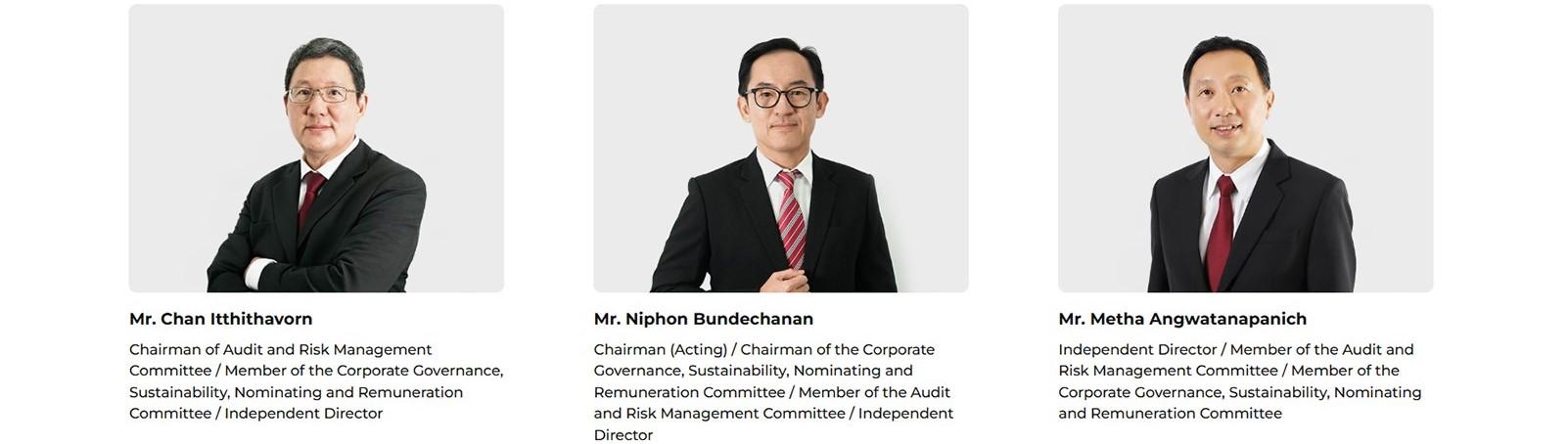
Audit Committee Charter
| Roles, Duties and Responsibilities | Type of Subcommittee | Link to the Charter |
|---|---|---|
Duties and Responsibilities regarding Audit:
1. To review that the Company and its subsidiaries' financial reports are accurate as they should be, in accordance with generally accepted accounting principles, and are adequately disclosed.
2. To review that the Company and its subsidiaries have appropriate and effective internal control systems, internal audit systems, and risk management policies, and to consider the independence of the internal audit unit, as well as to approve, in conjunction with the Chief Executive Officer, the appointment, transfer, or dismissal of the Head of the Internal Audit Unit or other external agencies responsible for internal audit.
3. To review that the Company complies with the Securities and Exchange Act, the Stock Exchange regulations, and other laws related to the business of the Company and its subsidiaries.
4. To consider, select, propose, and appoint independent individuals to serve as the Company's auditors, as well as to dismiss the Company's auditors and propose their remuneration. This includes holding at least one meeting per year with the auditors without the presence of management. The auditor shall cease to perform duties for the Company in the following cases:
1) The auditor violates and/or fails to comply with Section 89/25 of the Securities and Exchange Act B.E. 2535 (as amended).
2) The certified public accountant license becomes ineffective under the law on the accounting profession.
3) The auditor commits professional misconduct, violates, or fails to comply with the code of ethics for auditors in a material way, and receives a suspension or revocation of their license under the law on the accounting profession.
4) The auditor is determined by the Council of the Federation of Accounting Professions to have behavior that brings discredit to the accounting profession.
5. To consider and provide opinions on connected transactions or transactions that may have conflicts of interest, in compliance with laws and Stock Exchange regulations, to ensure that such transactions are reasonable and provide the utmost benefit to the Company.
6. To prepare the report of the Audit and Risk Management Committee, to be disclosed in the Company's annual report. Such report must be signed by the Chairman of the Audit and Risk Management Committee and must include at least the following information:
1) Opinion on the accuracy, completeness, and reliability of the Company's financial reports.
2) Opinion on the adequacy of the Company's internal control system.
3) Opinion on compliance with the Securities and Exchange Act, the Stock Exchange of Thailand regulations, or laws related to the Company's business.
4) Opinion on the suitability of the auditor.
5) Opinion on transactions that may have conflicts of interest.
6) Number of Audit and Risk Management Committee meetings and attendance of each audit committee member.
7) Overall opinions or observations obtained by the Audit and Risk Management Committee from performing its duties according to the Audit and Risk Management Committee Charter.
8) Other items that shareholders and general investors should be aware of, within the scope, duties, and responsibilities assigned by the Board of Directors.
7. To review and provide opinions on the internal audit plan and the performance of the internal audit unit in carrying out its duties. The Audit and Risk Management Committee has the authority to invite relevant management, executives, or employees of the Company to provide opinions, attend meetings, or submit documents as deemed necessary.
8. In performing its duties, if the Audit and Risk Management Committee finds or suspects any of the following items or actions that may significantly affect the Company's financial position and operating results, the Audit and Risk Management Committee shall report to the Board of Directors for corrective action within a timeframe deemed appropriate by the Audit and Risk Management Committee:
1) Transactions that may have conflicts of interest.
2) Fraud or significant irregularities or deficiencies in the internal control system.
3) Violation of the Securities and Exchange Act, the Stock Exchange of Thailand regulations, or laws related to the Company's business. If the Board of Directors or management fails to take corrective action within the timeframe deemed appropriate by the Audit and Risk Management Committee, any member of the Audit and Risk Management Committee may report such items or actions to the Office of the Securities and Exchange Commission or the Stock Exchange of Thailand.
9. To assess the adequacy and suitability of the anti-fraud risk management policy and the systems used for risk management, with the primary responsibility for organizational risk management as follows:
1) To review the internal audit plan of the internal audit unit to cover the review of internal controls for anti-corruption measures and related policies, as well as fraud risks in other operational processes.
2) To acknowledge fraud-related reports, including periodic updates on fraud risk management, serious fraud incidents, investigation outcomes, and penalties.
3) To consult with the auditor in the event that the Company experiences significant fraud incidents.
10. To review the Audit and Risk Management Committee Charter and propose it for Board approval.
11. To have the authority to seek independent opinions from other professional advisors when deemed necessary, at the Company's expense.
12. To evaluate performance by self-assessment and report the evaluation results, along with any obstacles in performance that may prevent the achievement of the objectives for which the Audit and Risk Management Committee was established, to the Board of Directors annually.
13. To perform any other duties assigned by the Board of Directors with the approval of the Audit and Risk Management Committee.
Duties and Responsibilities regarding Risk Management:
1. To consider, establish, revise, and review the adequacy of the organizational risk management policy and framework, including the positive and negative impacts of risks, at least once a year, to align with the Company's objectives, strategies, and operational goals. This includes various types of risks, including but not limited to strategic risks, operational risks, financial risks, compliance risks with laws, regulations, and rules, and environmental, social, community, and governance risks. This also includes supervising and supporting each business unit of the group to effectively and efficiently implement risk management in accordance with the established organizational risk management policy and framework.
2. To consider, establish, review, and approve risk assessments, risk response methods, risk management plans proposed by management, and risk reports, and to oversee the risk management process by identifying risks that may affect the group, from both internal and external factors, to assess the impact and likelihood of potential risks, prioritize risks, and establish action plans and measures for risk management, to ensure that such risks are at an appropriate and acceptable level. This also includes defining the acceptable risk level (Risk Appetite) and the deviation from the acceptable risk level (Risk Tolerance) for the group.
3. To consider emerging risks that may have a long-term impact on the Company, including establishing action plans and measures for managing such risks.
4. To promote and support the continuous development and improvement of risk management processes, including the ongoing development of various tools and information systems, as well as to foster an effective risk management culture within the organization.
5. To regularly control and monitor risk management results, including assessing the potential likelihood of risks from the group's operations. Additionally, the Audit and Risk Management Committee should establish an early warning system for risk monitoring by defining appropriate Key Risk Indicators to ensure that each business unit can respond to emerging risks promptly and appropriately, and in accordance with established guidelines.
6. The Audit and Risk Management Committee may request necessary documents from relevant departments to perform its duties and responsibilities, and may invite executives and/or relevant officers to attend meetings to clarify and provide information as deemed appropriate by the Audit and Risk Management Committee.
7. To establish a Risk Management Working Group to assist with various tasks, and to appoint independent advisors with knowledge and expertise to provide consultation, advice, and assistance to the Audit and Risk Management Committee.
8. To acknowledge the report on the audit results of the risk management process prepared by the Company's internal audit unit from the Risk Management Working Group at least once a year.
9. To evaluate annual risk performance and report the evaluation results to the Board of Directors.
10. To perform any other duties related to risk management as assigned by the Board of Directors or as prescribed by law or relevant authorities.
| 3091 · Description: Audit of financial statements and internal controls · 3092 · Description: Risk management | https://investor.prtr.com/storage/content/corporate-governance/charter-board-and-subcommittee/prtr-audit-committee-handbook-th.pdf |
Audit Committee Members
| Title | First Name | Last Name | Position | Gender | Year of Birth | Nationality | Resident in Thailand? | Appointment Date | Highest Education | Field of Study | Field of Study — Please Specify | Has Accounting or Financial Expertise? | Skills & Expertise | Meetings Held | Meetings Attended | Meeting Allowance (Baht) | Other Remuneration (Baht) | Total Remuneration (Baht) | Remuneration from Subsidiaries (Baht) | Non-monetary Remuneration |
|---|---|---|---|---|---|---|---|---|---|---|---|---|---|---|---|---|---|---|---|---|
| Mr. | Chan | Itthithavorn | Chairman of the audit committee | M | 1,968 | 643 · Description: Thailand | Y | 2019-11-11T00:00 | Master's degree | Business Administration | Y | 1683 · Description: Business Administration · 143 · Description: Accounting · 144 · Description: Finance · 150 · Description: IT Management · 167 · Description: Internal Control | 4 | 4 | 160,000 | 0 | 160,000 | 0 | 0 | |
| Mr. | Niphon | Bundechanan | Audit committee | M | 1,971 | 643 · Description: Thailand | Y | 2019-11-11T00:00 | Doctoral degree | other | Industrial Management | N | 165 · Description: Risk Management · 163 · Description: Leadership · 164 · Description: Strategic Management · 158 · Description: Corporate Management · 167 · Description: Internal Control | 4 | 4 | 100,000 | 0 | 100,000 | 0 | 0 |
| Mr. | Metha | Angwattanapanich | Audit committee | M | 1,967 | 643 · Description: Thailand | Y | 2024-05-14T00:00 | Master's degree | Business Administration | N | 159 · Description: Engineering · 1683 · Description: Business Administration · 165 · Description: Risk Management · 164 · Description: Strategic Management · 167 · Description: Internal Control | 4 | 4 | 100,000 | 0 | 100,000 | 0 | 0 |
Audit Committee — Meeting Allowance (Baht)
360000.0
Audit Committee — Other Remuneration (Baht)
0.0
Audit Committee — Total Remuneration (Baht)
360000.0
Executive Committee
Executive Committee — Introduction

Executive Committee Charter
| Roles, Duties and Responsibilities | Type of Subcommittee | Link to the Charter |
|---|---|---|
1. Operate and manage the company's business in accordance with its objectives, articles of association, policies, regulations, requirements, and resolutions of the Board of Directors' meetings and/or shareholders' meetings.
2. Control, supervise, and monitor the company's performance to ensure it aligns with established policies, goals, business plans, business strategies, and budgets, as well as various management authorities approved by the Board of Directors, to operate efficiently and effectively in support of the business environment, and to provide consultation and management advice to senior executives.
3. Review and screen management proposals and present the company's goals, policies, strategies, business plans, and annual budget before submitting them to the Board of Directors for consideration and approval.
4. Approve significant capital expenditures as stipulated in the annual expenditure budget, as delegated by the Board of Directors, or as previously approved in principle by the Board of Directors.
5. Have the authority to consider and approve expenses for the company's normal business operations, in accordance with the budget approved by the Board of Directors, with the limit for each item adhering to the approval authority matrix previously approved by the Board of Directors.
6. Monitor the performance and progress of investment projects for each business, and report the results, including any problems or obstacles encountered and proposed solutions, to the Board of Directors.
7. Propose an organizational structure suitable for the company's operations to the Corporate Governance, Sustainable Development, Nomination, and Remuneration Committee for endorsement before submitting it to the Board of Directors for consideration and approval.
8. Consider the profit and loss of the company and its subsidiaries, and propose interim or annual dividend payments for the Board of Directors' approval.
9. Have the authority to consider and propose the annual budget for employee salary increases or adjustments, and the payment of annual bonuses to employees of the company and its subsidiaries, by presenting it to the Board of Directors for approval as part of the annual budget.
10. Arrange for executives, management, or employees to attend Executive Committee meetings, or to prepare and provide information relevant to matters to be discussed at Executive Committee meetings.
11. Procure consultants or independent individuals to provide opinions or advice as necessary.
12. Have the authority to delegate powers to one or more other persons to perform any act, under the control of the Executive Committee, or may delegate powers to such persons as the Executive Committee deems appropriate and for such period as the Executive Committee deems appropriate. The Executive Committee may revoke, withdraw, change, or amend the delegated persons or the delegation as it deems appropriate.
| 3093 · Description: Director and executive nomination · 3096 · Description: Sustainability development · 3095 · Description: Corporate governance · 3094 · Description: Remuneration | https://investor.prtr.com/storage/content/corporate-governance/charter-board-and-subcommittee/prtr-executive-committee-handbook-th.pdf |
Executive Committee Members
| Title | First Name | Last Name | Position | Gender | Year of Birth | Nationality | Resident in Thailand? | Appointment Date | Highest Education | Field of Study | Field of Study — Please Specify | Meetings Held | Meetings Attended | Meeting Allowance (Baht) | Other Remuneration (Baht) | Total Remuneration (Baht) | Remuneration from Subsidiaries (Baht) | Non-monetary Remuneration |
|---|---|---|---|---|---|---|---|---|---|---|---|---|---|---|---|---|---|---|
| Ms. | Risara | Charoenpanich | Chairman of the executive committee | F | 1,978 | 643 · Description: Thailand | Y | 2022-03-01T00:00 | Master's degree | other | Marketing Communication | 12 | 12 | 0 | 0 | 0 | 0 | |
| Mr. | Luck | Dendee | Member of the executive committee | M | 1,969 | 643 · Description: Thailand | Y | 2022-03-01T00:00 | Bachelor's degree | Business Administration | 12 | 12 | 0 | 0 | 0 | 0 | 0 | |
| Ms. | Onrudee | Kettawee | Member of the executive committee | F | 1,980 | 643 · Description: Thailand | Y | 2022-03-01T00:00 | Master's degree | other | Marketing | 12 | 12 | 0 | 0 | 0 | 0 | 0 |
| Mr. | Phukphong | Ratanaprapai | Member of the executive committee | M | 1,971 | 643 · Description: Thailand | Y | 2022-03-01T00:00 | Master's degree | Business Administration | 12 | 12 | 0 | 0 | 0 | 0 | 0 | |
| Ms. | Narita | Adulkaewphaluek | Member of the executive committee | F | 1,977 | 643 · Description: Thailand | Y | 2022-03-01T00:00 | Master's degree | Business Administration | 12 | 12 | 0 | 0 | 0 | 0 | 0 |
Executive Committee — Meeting Allowance (Baht)
0.0
Executive Committee — Other Remuneration (Baht)
0.0
Executive Committee — Total Remuneration (Baht)
0.0
Other Subcommittees
Other Subcommittees — Introduction
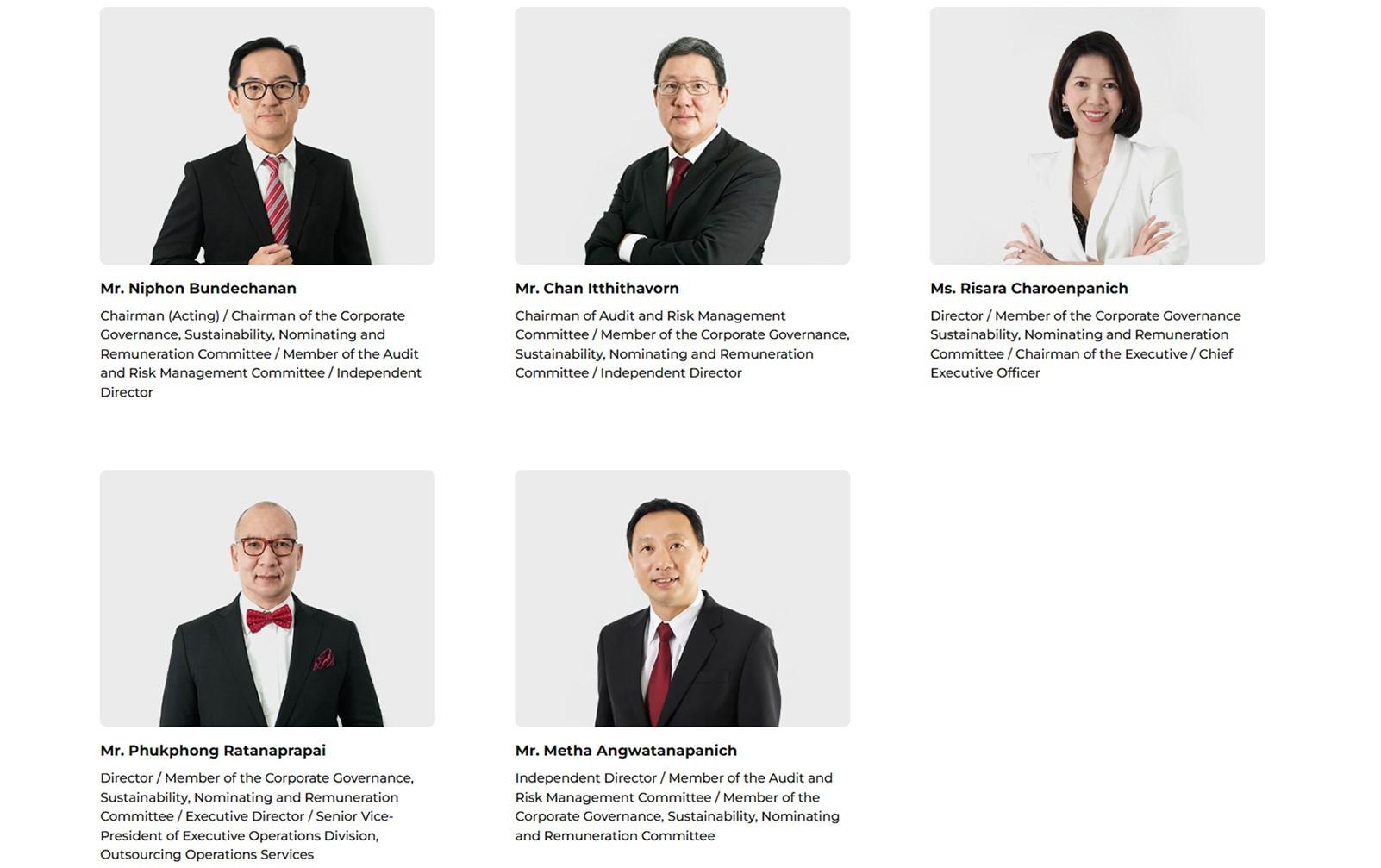
Other Subcommittees
| Subcommittee Name | Type of Subcommittee | Roles, Duties and Responsibilities | Link to the Charter | Meetings Held | Subcommittee Remuneration | Members |
|---|---|---|---|---|---|---|
| Corporate Governance, Sustainability, Nominating and Remuneration Committee | 3097 · Other name: Corporate Governance · Description: Others · 3097 · Other name: Sustainable Development · Description: Others · 3097 · Other name: Recruitment and Compensation · Description: Others | Corporate Governance:
1. Develop and recommend corporate governance practices suitable for the Company and consistent with the principles of good corporate governance of the Stock Exchange of Thailand, for submission to the Board of Directors.
2. Monitor the Company's operations to ensure compliance with the Company's good corporate governance practices as approved by the Board of Directors.
3. Review the Company's good corporate governance practices by comparing them with international good corporate governance principles and those of the Stock Exchange of Thailand, and submit them to the Board of Directors for continuous improvement.
4. Review the business philosophy, business ethics, operational ethics, employee ethics, and related practices as appropriate, for submission to the Board of Directors.
5. Perform any other duties related to good corporate governance as assigned by the Board of Directors.
Sustainable Development:
1. Review the Company’s ESG policies, goals, and strategies.
2. Oversee and assess sustainability performance in line with best practices.
3. Review ESG disclosures in the annual report (Form 56-1 One Report).
4. Perform other duties as assigned by the Board.
Nomination and Remuneration:
1. Recommend the structure, size, and composition of the Board of Directors and various sub-committees, including defining qualifications, criteria, and policies for considering nominees for selection as directors and sub-committee members, in accordance with the prescribed board structure, size, and composition.
2. Consider and propose names of individuals for appointment as company directors, sub-committee members, and Chief Executive Officer, for submission to the Board of Directors meeting and/or the Shareholders' meeting, in the event of a vacancy.
3. Consider policies and guidelines for determining monetary and non-monetary remuneration for the Board of Directors, sub-committees, and the Chief Executive Officer, in line with the Company's performance and that of other companies in the same industry, for submission to the Board of Directors and/or the Shareholders' meeting for further approval.
4. Set evaluation criteria for the CEO.
5. Review CEO and senior executive succession plans.other duties as assigned by the Board of Directors. | https://investor.prtr.com/storage/content/corporate-governance/charter-board-and-subcommittee/prtr-nomination-and-remuneration-committee-handbook-th.pdf | 2 | 100000.0 · Meeting allowance: 100000.0 · Other remuneration: 0.0 | 260 · Last name: Bundechanan · Position: 37 · First name: Niphon · Total meeting: 2 · Meeting allowance: 40000.0 · Other remuneration: 0.0 · Total remuneration: 40000.0 · Total meeting attendance: 2 · Non monetary remuneration: 0 · Total subsidiary remuneration: 0.0 · 260 · Last name: Itthithavorn · Position: 39 · First name: Chan · Total meeting: 2 · Meeting allowance: 30000.0 · Other remuneration: 0.0 · Total remuneration: 30000.0 · Total meeting attendance: 2 · Non monetary remuneration: 0 · Total subsidiary remuneration: 0.0 · 260 · Last name: Angwattanapanich · Position: 39 · First name: Metha · Total meeting: 2 · Meeting allowance: 30000.0 · Other remuneration: 0.0 · Total remuneration: 30000.0 · Total meeting attendance: 2 · Non monetary remuneration: 0 · Total subsidiary remuneration: 0.0 · 261 · Last name: Charoenpanich · Position: 39 · First name: Risara · Total meeting: 2 · Meeting allowance: 0.0 · Other remuneration: 0.0 · Total remuneration: 0.0 · Total meeting attendance: 2 · Non monetary remuneration: 0 · Total subsidiary remuneration: 0.0 · 260 · Last name: Ratanaprapai · Position: 39 · First name: Phukphong · Total meeting: 2 · Meeting allowance: 0.0 · Other remuneration: 0.0 · Total remuneration: 0.0 · Total meeting attendance: 2 · Non monetary remuneration: 0 · Total subsidiary remuneration: 0.0 |
Executives
Names and Positions — Introduction

Executives
| Title | First Name | Last Name | Position | Gender | Year of Birth | Nationality | Resident in Thailand? | Appointment Date | Highest Education | Field of Study | Field of Study — Please Specify | Skills & Expertise | Is the Highest-ranking Executive? | Is the Highest-ranking Accounting or Finance Officer? | Directly Responsible for Accounting? | Appointed After the End of the Fiscal Year? |
|---|---|---|---|---|---|---|---|---|---|---|---|---|---|---|---|---|
| Ms. | Risara | Charoenpanich | Chief Executive Officer | F | 1,978 | 643 · Description: Thailand | Y | 2012-03-12T00:00 | Master's degree | other | Marketing Communication | 1683 · Description: Business Administration · 142 · Description: Marketing · 163 · Description: Leadership · 164 · Description: Strategic Management · 146 · Description: Human Resource Management | Y | N | N | N |
| Mr. | Luck | Dendee | Senior Vice President, Talent Acquisition | M | 1,969 | 643 · Description: Thailand | Y | 2018-07-01T00:00 | Bachelor's degree | Business Administration | 146 · Description: Human Resource Management · 1683 · Description: Business Administration · 151 · Description: Data Management · 158 · Description: Corporate Management · 164 · Description: Strategic Management | N | N | N | N | |
| Ms. | Onrudee | Kettawee | Senior Vice President, Sales and Recruitment, Staffing Management | F | 1,980 | 643 · Description: Thailand | Y | 2018-10-03T00:00 | Master's degree | other | Marketing | 142 · Description: Marketing · 146 · Description: Human Resource Management · 1683 · Description: Business Administration · 112 · Description: Economics · 151 · Description: Data Management | N | N | N | N |
| Mr. | Phukphong | Ratanaprapai | Senior Vice President, Staffing Services | M | 1,971 | 643 · Description: Thailand | Y | 2019-11-11T00:00 | Master's degree | Business Administration | 142 · Description: Marketing · 146 · Description: Human Resource Management · 1683 · Description: Business Administration · 158 · Description: Corporate Management · 163 · Description: Leadership | N | N | N | N | |
| Ms. | Narita | Adulkaewphaluek | Senior Vice President, Corporate Administration | F | 1,977 | 643 · Description: Thailand | Y | 2019-11-11T00:00 | Master's degree | Business Administration | 143 · Description: Accounting · 147 · Description: Sustainability · 265 · Description: Governance/ Compliance · 168 · Description: Budgeting | N | N | N | N | |
| Mr. | David | Pollock | Senior Vice President, Executive Talent Acquisition | M | 1,972 | 657 · Description: United Kingdom | Y | 2010-01-11T00:00 | Master's degree | other | Master of Arts in History | 146 · Description: Human Resource Management · 164 · Description: Strategic Management · 1683 · Description: Business Administration | N | N | N | N |
| Mr. | Teeraphat | Petporee | Chief Financial Officer | M | 1,975 | 643 · Description: Thailand | Y | 2023-09-01T00:00 | Master's degree | Business Administration | 1683 · Description: Business Administration · 144 · Description: Finance · 143 · Description: Accounting | N | Y | N | N | |
| Ms. | Kanlaya | Pattarakulsri | Assistant Director, Accounting and Finance Department | F | 1,980 | 643 · Description: Thailand | Y | 2021-08-01T00:00 | Master's degree | Accounting | 143 · Description: Accounting · 144 · Description: Finance | N | N | Y | N |
Executive Remuneration
Monetary Remuneration
| Metric | Current Year | Previous Year | Two Years Ago |
|---|---|---|---|
| Total remuneration of executive directors and executives (baht) | 34,638,477 | 31,492,671 | 28,662,735 |
| Total remuneration of executive directors (baht) | 0 | 0 | 0 |
| Total remuneration of executives (baht) | 34,638,477 | 31,492,671 | 28,662,735 |
Other Remuneration — Description
The Company has established an Employer-Employee Joint Investment Program (Employee Joint Investment Program: EJIP), which encourages executives and employees to participate in company ownership, creating an incentive for performance and retaining personnel with the Company in the long term. The project has a duration of 3 years, commencing on May 1, 2025, to April 30, 2028. The Company will deduct employee salaries, and the Company will contribute to employees participating in the program at a rate of 100 percent of the employee's monthly investment value.
In the year 2025, 6 senior executives participated in the program, and the Company contributed a total of 0.58 million Baht.
Other Remuneration
| Metric | Current Year | Previous Year | Two Years Ago |
|---|---|---|---|
| Company’s contribution to provident fund for executive directors and executives (Baht) | 929,178.75 | 832,971 | 649,035 |
| Employee Stock Ownership Plan (ESOP) | 0 | 0 | 0 |
| Employee Joint Investment Program (EJIP) | 1 | 0 | 0 |
Remuneration or Benefits Payable to Executives
| Metric | Amount (Baht) |
|---|---|
| Outstanding remuneration or benefits of executive directors and executives in the past year (baht) | 0 |
| Estimated remuneration of executive directors and executives in the current year (baht) | 0 |
Remuneration Policy
Executive Remuneration Policy
Appropriate Remuneration Structure and Performance Evaluation
Criteria and Methods for Director Remuneration Consideration
The Company has established written criteria and methods for determining director remuneration to incentivize and retain qualified directors with appropriate qualifications, knowledge, abilities, and experience for business operations. The Nomination and Remuneration Committee considers and proposes director remuneration to the Board of Directors for submission to the Shareholders' Meeting for approval. These criteria consider appropriateness and comparability with industry standards at the same level.
Criteria and Process for Remuneration Consideration of the Board of Directors and Sub-committees
The Corporate Governance, Sustainable Development, Nomination, and Remuneration Committee uses the following criteria to determine remuneration:
Guidelines for Director Remuneration Consideration
Consider remuneration based on the roles, duties, responsibilities, and workload of the Board of Directors and sub-committees.
Consider the type, method of payment, and amount of remuneration for directors and sub-committee members.
Consider remuneration in line with the duties, responsibilities, dedication of directors, type and size of business, as well as market conditions and competitors. The remuneration must be at an appropriate and sufficient level to attract and retain qualified directors.
The Corporate Governance Committee also considers and determines the remuneration of the Chief Executive Officer as an executive.
Types of Director Remuneration
Directors receive only one type of remuneration: meeting attendance fees, paid solely based on the number of meetings attended. No other forms of remuneration, such as annual remuneration, bonuses, or other benefits, are provided. This is in accordance with the resolution of the Annual General Meeting of Shareholders. 2568, which stipulates that the remuneration structure can be summarized as follows:
Meetings | Meeting attendance fees | |
Chairman | Director | |
Board of Directors | 60,000 | 40,000 |
Audit and Risk Management Committee | 40,000 | 25,000 |
Corporate Governance, Sustainable Development, Nomination, and Remuneration Committee | 20,000 | 15,000 |
Executive Remuneration
The Company has established an appropriate remuneration structure that serves as an incentive for senior executives to perform in alignment with the organization's main objectives and goals, as well as with the company's long-term interests. This structure emphasizes fairness, appropriateness, and the creation of motivation to drive the organization towards sustainable growth.
The Company has clearly stipulated the criteria and methods for determining the Chief Executive Officer's remuneration in writing. The appropriateness of the existing criteria is regularly reviewed and compared with remuneration data from other companies in the same industry to ensure that the remuneration is market-aligned, appropriate, fair, and reflects the performance and responsibilities of the position, as well as to reward personnel who play a crucial role in the company's success.
In determining the Chief Executive Officer's remuneration, the Company assigns the Corporate Governance, Sustainable Development, Nomination, and Remuneration Committee to review and refine appropriate criteria and guidelines before submitting them to the Board of Directors for approval.
Criteria and Methods for Executive Remuneration Consideration
Guidelines for Executive Remuneration Consideration
The Board of Directors, with the approval of the Corporate Governance, Sustainable Development, Nomination, and Remuneration Committee, establishes a remuneration structure that incentivizes the Chief Executive Officer, executives, and employees at all levels to perform in line with the organization's main objectives and goals, as well as to align with the company's best interests.
The Board of Directors assigned the Corporate Governance Committee to consider and propose the criteria, amount, and forms of remuneration for the Chief Executive Officer, both short-term and long-term, based on relevant key performance indicators, including performance evaluation results and business achievements. Ability to develop the organization towards sustainability according to principles ESG and comparison with other listed companies on the stock exchange before submission to the Board of Directors for consideration and approval. The evaluation criteria must be capable of incentivizing the Chief Executive Officer to manage the business in alignment with long-term goals, strategies, and the best interests of the enterprise. Furthermore, the criteria, evaluation results, and development issues must be communicated to the Chief Executive Officer annually.
For senior executives, the Chief Executive Officer is responsible for determining individual remuneration based on each executive's performance, referencing relevant key performance indicators and in accordance with the remuneration and welfare system approved by the Corporate Governance Committee, which includes short-term benefits such as annual salary adjustments and annual bonuses.
The Board of Directors assigned the Corporate Governance Committee to establish and oversee a performance evaluation system and a mechanism for determining remuneration and welfare benefits for employees at all levels, in accordance with the remuneration structure and policies set by the Board of Directors.
Types of Executive Remuneration
1 Fixed Remuneration and Benefits
Salary and Fixed Remuneration (Fixed Allowance) : The level of salary and fixed remuneration is determined by the duties, responsibilities of the position, experience, and unique capabilities of the executive. The rates are set according to criteria in comparable industries, considering the roles and responsibilities of the company's management levels and payment rates based on standard labor market salaries, as well as considering the progress of operational performance against the company's annual success metrics, which are clear standard criteria reviewed annually.
Other Benefits and Special Benefits : The main objective of providing benefits and special benefits is to ensure employee security and assist in improving the quality of life for executives and their families, such as medical expenses, life insurance, health insurance plans, provident funds, and various welfare benefits according to company regulations and legal requirements.
2 Performance-based Remuneration
Bonus and Performance-based incentive: This is a variable reward based on short-term performance achievements compared to the annual plan. It considers the progress of operational performance against the company's annual success metrics, which are clear standard criteria reviewed annually, including both financial results and other factors, by evaluating the performance of the company and individual employees.
Long-term Remuneration : Long-term remuneration is a form of compensation that promotes long-term growth for the company and its shareholders, serves as a key incentive for important company executives, and reflects the efficiency of the company's growth.
The company has established the project EJIP (Employee Joint Investment Program) is a form of long-term remuneration for executives, designed to incentivize efficient performance and promote sustainable growth for the company and its shareholders. The objective of the EJIP program is to enable executives to participate in the company's shareholding, fostering long-term commitment and motivating executives to focus on positive long-term outcomes for the organization.
Was an Opinion Obtained from the Board and the Remuneration Committee?
Yes
Opinion of the Board and the Remuneration Committee
The Corporate Governance, Sustainable Development, Nomination, and Remuneration Committee has considered and established the remuneration for directors and executives. This determination is based on the alignment with each individual's responsibilities and performance. Upon comparison with companies within the same industry and those of similar size, the Corporate Governance, Sustainable Development, Nomination, and Remuneration Committee considers the remuneration to be at an appropriate level, sufficient to attract and retain high-quality directors and executives within the company.
Link to the Remuneration Policy
https://investor.prtr.com/storage/content/corporate-governance/cg-policy/prtr-cg-policy-th.pdf
Page in the Report
14
Employees
Any Significant Change in Headcount in the Past 3 Years?
No
Employee Remuneration
Nature of Employee Remuneration
The company has a policy of providing fair, appropriate, and competitive employee compensation in the labor market. This is determined in alignment with the duties, responsibilities, position level, and performance of each employee. Furthermore, the company has established a compensation structure based on principles of fairness, transparency, and non-discrimination, regardless of department, age, gender, or any other status. It adheres to the principle of equity to ensure that employees performing comparable roles in terms of responsibility level, job characteristics, and complexity receive appropriate and equal compensation. Regarding employee compensation in 2025, it refers to the compensation paid by the company to employees during the 2025 fiscal year, which covers compensation components based on the benefits and performance of each employee, including regular salary, performance-based bonuses, welfare benefits paid through the payroll system, performance commissions, and overtime pay. Such compensation payments are in accordance with the company's human resource management policies, criteria, and guidelines. Note: Employee remuneration for the year 2025 excludes other benefits, such as financial assistance, including medical expenses and death benefits.
Provident Fund
Does the Company Have a Provident Fund?
Yes
Provident Fund Policy
The Company has established a provident fund, managed by Bangkok Capital Asset Management Co., Ltd. under the name "Bualuang Wealth Provident Fund," effective December 1, 2018. The Company and its subsidiaries set the employer's contribution rate at 3% of wages. For employees, the Company has adjusted the contribution rate from the previously set 3% to a range between 3% and 15%, based on the employees' discretion. To encourage employees to continuously participate in savings, create an incentive for working with the company, and instill financial discipline for future security.
Does the Fund Committee Follow the I Code?
Yes
Policy for Employees Not in the Provident Fund
Automatic Enrolment
No
Encouraging Retirement Saving
No
Providing Investment Information
No
Other Measures
Yes
Other Measures — Details
| Measure | Details |
|---|---|
| Promoting savings through provident funds for employees who are not yet members of the PVD. | Monthly communication for employees eligible to participate in the fund. |
Auditors and Audit Fees
How Audit Fees Are Reported
TOTAL
Company Auditor and Fees
| Audit Firm | Sub-district | District | Province | Postcode | Fax | Auditors | Audit Fee (Baht) | Any Non-audit Fee? | Type of Non-audit Service | Non-audit Service Details | Non-audit Fee (Baht) |
|---|---|---|---|---|---|---|---|---|---|---|---|
| DELOITTE TOUCHE TOHMATSU JAIYOS AUDIT COMPANY LIMITED | YAN NAWA | SATHON | Bangkok | 10120 | +66 2034 0100 | pjongkolsiri@deloitte.com · Title: 261 · Regis no: 7150 · Last name: JONGKOLSIRI · First name: PORAKOCH · Telephone: +66 2034 0000 · jjuntrachaichoat@deloitte.com · Title: 261 · Regis no: 6326 · Last name: JUNTRACHAICHOAT · First name: JUNTIRA · Telephone: +66 2034 0000 · wsujarit@deloitte.com · Title: 260 · Regis no: 7103 · Last name: SUJARIT · First name: WEE · Telephone: +66 2034 0000 · lmagut@deloitte.com · Title: 261 · Regis no: 9039 · Last name: MAGUT · First name: LASITA · Telephone: +66 2034 0000 | 2,430,000 | Y | Information Technology (IT) Audit Fee | Information Technology (IT) Audit Fee | 104,673 |
Company Secretary and Other Assigned Persons
Company Secretary — Introduction
The Board of Directors has appointed Ms. Narita Adulkaewphaluek to serve as Company Secretary from 11 November 2019 ( History appears in the attached document. 1) with the following scope of duties and responsibilities:
(a) Prepare and maintain the register of company directors, notices of Board of Directors meetings, minutes of Board of Directors meetings, annual reports, notices of shareholder meetings, and minutes of shareholder meetings.
(b) Establish a system for retaining relevant documents and evidence, and ensure they are stored accurately, completely, and verifiably for no less than 5 years, including:
Information for requesting shareholder meeting resolutions
Financial statements and reports on the company's financial position and operating results, or other reports required to be disclosed under securities and stock exchange laws.
The company's opinion when a tender offer for securities is made by shareholders.
Information or reports concerning the business that must be disclosed to shareholders or the public as prescribed by the Capital Market Supervisory Board.
Document retention includes storage using computer systems or retrievable media without alteration of text.
(c) Maintain reports of interests made by directors or executives, and submit copies to the Chairman of the Board and the Chairman of the Audit Committee within 7 business days.
(d) Provide initial advice on the company's laws, regulations, and bylaws, and report significant changes in laws or regulations to the Board of Directors.
(e) Arrange shareholder meetings and Board of Directors meetings in compliance with relevant laws, regulations, and practices.
(f) Record minutes of shareholder and Board of Directors meetings, and monitor the implementation of resolutions.
(g) Oversee the disclosure of information and information reports under responsibility to regulatory agencies to ensure accuracy and completeness.
(h) Oversee the activities of the Board of Directors and perform other duties as prescribed by law and/or by the Capital Market Supervisory Board, including other tasks assigned by the Board of Directors.
(i) Perform any other duties as prescribed by the Capital Market Supervisory Board.
The details of the Company Secretary's work history, educational background, and training are provided in the attached document. 1
Company Secretary
| Title | First Name | Last Name | Telephone | |
|---|---|---|---|---|
| Ms. | Narita | Adulkaewphaluek | narita@prtr.com | 083-988-4852 |
Chief Accountant
| Title | First Name | Last Name | Telephone | |
|---|---|---|---|---|
| Ms. | Kanlaya | Pattarakulsri | kanlaya@prtr.com | 081-755-0745 |
Head of Internal Audit — Introduction
The Audit Committee meeting resolved to appoint PricewaterhouseCoopers ABAS Ltd. to conduct an audit and evaluate the effectiveness of the internal control systems of the Company and its subsidiaries. Ms. Chalida Kongprajya was assigned to the position of Head of Internal Audit, responsible for independently and impartially auditing and monitoring the evaluation of internal control systems and risk management, and reporting the results directly to the Audit Committee. This is to ensure that the Company's internal control systems are appropriate, adequate, and effective in accordance with relevant criteria.
Furthermore, the Company has clearly defined the scope, duties, and responsibilities of the Internal Audit Department, covering the audit of asset utilization, compliance with internal policies and regulations, financial controls, accounting records and information systems, as well as monitoring the rectification of identified deficiencies. This is to strengthen appropriate internal control systems and reduce the risk of fraud or operational errors.
The Company has appointed Ms. Prapaporn Injeen as the Head of Compliance Unit, responsible for coordinating between the Company and the internal auditor. The details of the work history and qualifications of the Head of Internal Auditor are presented in Annex 3.
Head of Internal Audit
| Title | First Name | Last Name | Telephone | |
|---|---|---|---|---|
| Ms. | Chalida | Kongprajya | chalida.kongprajya@th.pwc.com | +66 2844 1000 |
Head of Compliance — Introduction
The Company has a unit responsible for overseeing compliance with laws, regulations, and various rules of regulatory bodies related to the Company's business operations. Ms. Prapaporn Injeen holds the position of Head of the Company's Compliance Unit, responsible for supervising, overseeing, and monitoring to ensure that the Company's operations comply with relevant laws and regulations accurately and completely. Details regarding the work history, education, and related information of the Head of the Compliance Unit are provided in Annex 1.
Head of Compliance
| Title | First Name | Last Name | Telephone | |
|---|---|---|---|---|
| Ms. | Prapaporn | Injeen | prapaporn.in@prtr.com | 083-988-5397 |
Investor Relations Contact
Investor Relations — Introduction
The Company has established an Investor Relations department to serve as a central hub for disclosing information to shareholders, investors, and securities analysts, reporting information via the company's website under the Investor Relations section ( Investor Relations) which includes information reported by the Company to the Stock Exchange of Thailand and the Securities and Exchange Commission, as well as shareholder information, quarterly operating results, stock price movements, group businesses, and various activities. Information is regularly updated to be current, allowing shareholders and interested parties to access information quickly, equally, and completely as it is.
In 2568 The Company has fully and accurately disclosed information to the Stock Exchange of Thailand in accordance with the relevant disclosure requirements.
The Company respects the rights of shareholders, investors, and securities analysts by treating stakeholders fairly, being open to feedback and inquiries, and fostering mutual understanding to ensure confidence that the Company operates in accordance with regulations, maintains transparency, and can disclose material information appropriately and equally.
The Investor Relations department ensures transparent, fair, and timely disclosure of material information, enabling shareholders, investors, and analysts to make informed decisions.
Interested parties may contact the Company's Investor Relations department at
Investor Relations Department, PRTR Group Public Company Limited
Address : 2034/82 Italthai Tower, 18th Floor, New Petchburi Road, Bang Kapi Subdistrict, Huai Khwang District, Bangkok 10310
Does the Company Have an Investor Relations Contact?
Yes
Investor Relations Contacts
| Title | First Name | Last Name | Telephone | |
|---|---|---|---|---|
| Ms. | Narita | Adulkaewphaluek | ir@prtr.com | +66 (0) 63 237 3997 |
Representatives in Thailand (Foreign Companies)
Does the Company Have Representatives in Thailand?
No